Chalk Dust And Neurons In The Air
A room buzzing too loudly. Laughter tipping into chaos. A teacher’s patience snapping like chalk.
Chalk explodes into the air as the duster hits the table.
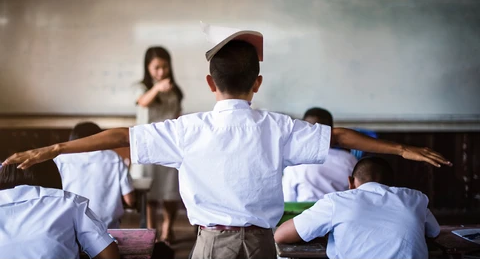
“Enough of this ruckus,” the chemistry teacher says.
“Everyone—stand up. Hands in the air.”
Most of us carry the same classroom memory, no matter where we grew up.
As children, we understood it as embarrassment. As injustice. As power misused. For most students, these acts were registered as punishment first and pedagogy never. Millennials especially remember it vividly—how those moments burned hotter than the mistake itself, how shame lingered longer than the lesson. Over time, these practices receded. Not because classrooms grew quieter, but because the emotional cost became louder. Bullying, resentment, and shame followed students far beyond the chalkboard.
Yet beneath the cultural controversy sits a physiological truth we rarely name.
Children are neurologically reactive, especially in social clusters. Their nervous systems are young, reactive, and exquisitely sensitive to social stimulus. Noise escalates, energy feeds energy, and before anyone realizes it, the room tips into sympathetic overdrive—the survival state of fight, flight, and unchecked impulse. What adults label as “misbehavior” is often a body flooded with stimulus, operating in danger mode rather than defiance.
Seen through this lens, these disciplinary practices were not purely about obedience or authority. They were crude, culturally inherited tools of nervous-system regulation. Forced stillness. Awkward posture. A break in momentum. A somatic interruption designed to pull the child out of reactive chaos and nudge the nervous system toward parasympathetic calm. Not punishment as a morality play, but as a nervous reset.
The intention wasn’t always kindness. But the mechanism was regulation. And beneath the controversy lies a biological reality. Across cultures and continents, classrooms have long doubled as laboratories of nervous-system management—whether they knew it or not.
In Japan, it is not uncommon to see young children sleeping in classrooms, heads resting on desks, bodies slumped into rest without reprimand. Fatigue is not moralized; it is understood as a signal. In parts of China, students engage in synchronized movements, prolonged standing, posture correction, and regimented stillness—practices often framed as discipline, but functioning as collective regulation. Elsewhere in the world, children were made to stand at the back of the room, kneel, hold books with outstretched arms, write lines endlessly, or sit isolated in “time-out” corners.
Different cultures. Different optics. Same somatic language.
Traditionally, when children became noisy, restless, or unruly in groups, the response was rarely verbal reasoning. Instead, it was a physical interruption. Arms raised. Movement restricted. Posture altered. Momentum broken. These acts were experienced by students as punishment—often embarrassing, sometimes humiliating, and frequently breeding resentment. Over time, the emotional cost became undeniable, and many of these practices were abandoned or softened, especially as awareness around shame, bullying, and psychological safety grew.
Long before neuroscience named the autonomic nervous system, societies understood something instinctively:
You cannot reason with a dysregulated body. First, you must calm it.